The Laboratory for Astrophysics at Leiden Observatory was the first of its kind in the world. In 1975 the Laboratory was founded by Mayo Greenberg. He demonstrated the importance of accurate laboratory data to guide and interpret astronomical observations. Prof. Greenberg has been in charge of the laboratory for nearly a quarter century and was involved in the ongoing research until far after his retirement. Many well known scientists have been working under his supervision; Profs. d’Hendecourt, Ehrenfreund, Tielens, and Allamandola, to mention a few. Today, the Laboratory for Astrophysics is still a unique facility where astronomers, physicists and chemists meet and work together to simulate and understand inter- and circumstellar processes. Fingerprint spectra of molecular species of astrophysical interest are recorded, both in the gas phase and in the solid state, and solid state reaction pathways, both of rather small and complex molecules are studied using state-of-the-art experimental setups.
Mayo Greenberg has been in charge of the laboratory up to his retirement in 1992 after which Ewine van Dishoeck has been formally leading the laboratory until 2004. In this period much of the daily work was taken care of by Willem Schutte and Pascale Ehrenfreund. Stephan Schlemmer (now Cologne) has been heading the group for a short period after 2004. From 2005 to 2023, Harold Linnartz was in charge of the Laboratory and under his supervision it has been significantly expanded. With eight specialized setups, research is nowadays performed with a focus on transient species of astrophysical interest in both gas phase and solid state as well as the spectroscopy of interstellar ices and fundamental properties of atom and photon induced processes in interstellar ice analogues.
Since its founding in 1975, the laboratory has produced more than 35 PhD theses. With roughly 600 scientific publications, it has made substantial contributions to our understanding of the physics and chemistry of interstellar and circumstellar processes. Today, it is one of the largest astrophysics laboratories embedded within an academic observatory. Many of its alumni remain active in academia, serving as assistant, associate, or full professors.
The laboratory has been active in several major astrochemistry networks, including NOVA (the Netherlands Research School for Astronomy), LASSIE and EUROPAH—two large European FP7/H2020 projects—the Dutch Astrochemistry Network (NWO-DAN), Planetary and Exoplanetary Science (NWO-PEPSci), and, most recently, INTERCAT. In 2024, the LfA moved into a new facility in the Gorlaeus Building (BM.4.26, Faculty of Science) and continues to advance our understanding of the universe through state-of-the-art experimental research.
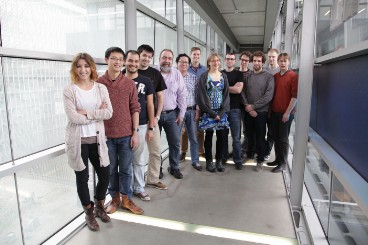
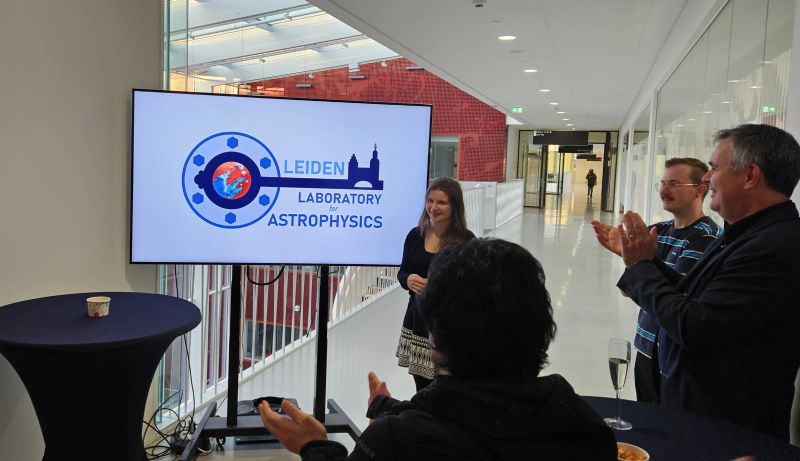
Group photos